



Your most experienced tech turns 55 this year. The last two hires you made didn't clear ninety days. And the applications coming across the desk look nothing like the ones you were reading in 2015.
That's the staffing picture most HVAC and plumbing owners are working with heading into fall, and it's why hiring Gen Z technicians has stopped being an HR project and turned into a capacity question. Every truck you can't staff is revenue you can't book. Every seat you fill with the wrong person costs you twice: once in wasted training, again in the callbacks that follow.
Here's what's changed. The pipeline is finally moving in your direction. Most shops are still running a hiring process built for a workforce that's already retiring.
The Talent Pool Got Deeper. Most Owners Haven't Noticed.
For most of the last decade, the workforce conversation ran one direction: not enough young people wanted in. That has shifted. Enrollment in two-year HVACR programs climbed from 20,153 students in spring 2024 to 25,971 in spring 2025, a gain of nearly 29%, according to National Student Clearinghouse figures reported by ACHR News. Four-year program enrollment rose over the same window.
Demand hasn't softened either. The Bureau of Labor Statistics projects about 40,600 openings a year for heating, air conditioning, and refrigeration mechanics and installers from 2024 through 2034, against roughly 425,200 people holding those jobs in 2024. On the plumbing side, BLS projects about 42,000 openings a year for plumbers, pipefitters, and steamfitters over the same decade, out of about 504,500 jobs. Most of that volume comes from retirements and people exiting the trade, not from expansion.
Read those two facts together. More candidates are entering, and more seats keep opening. The shops that win are simply the ones ready when a 22-year-old with a certificate starts looking.
What Gen Z Candidates Screen For Before They Ever Call You
A younger candidate is evaluating your company well before any interview. The job post, the reviews, the truck that passed them on the highway. Most of that screening happens without you.
Pay, posted
A listing without a number reads as a listing with something to hide. BLS puts the median annual wage for HVACR mechanics and installers at $61,010 as of May 2025, and plumbers, pipefitters, and steamfitters at $63,800 in May 2025. Those are national medians across all experience levels, so your market may run higher or lower. Post a real range anyway. A candidate comparing three shops will skip the one that makes them ask.
A path, not a job
The single fastest way to lose a good young hire is to leave the next three years blank. Where does an apprentice go at month six, year one, year three? What has to be true for them to run their own truck? Write it down. Hand it to them in the interview, on paper. When you're screening apprentice candidates, the questions worth asking a new recruit are mostly the ones that surface whether they want that path or just a paycheck this month.
Tools that aren't a decade behind
Younger techs arrive expecting the software to work. Hand them paper tickets and a dispatch process built around voicemail, and they read it as a signal about how the rest of the shop runs. The fix is cheap next to wages. It also shows up in retention faster than some things on the list.
Speed Is Most of the Game
Contracting Business reported this spring on how quickly the hiring window closes, with recruiters pointing to text messaging over email as the fastest, least invasive way to reach a technician who is already employed somewhere else. Good candidates in this trade are rarely unemployed. They're working for a competitor and mildly curious about you, and that curiosity has a shelf life measured in days.
The same piece makes a point most owners will recognize as true the moment they read it. Westie Magnuson, Chief Culture Officer at HireAligned, put it plainly: "If it's not one single person's responsibility and priority, it will never be done as well as it could be." Recruiting that belongs to everybody belongs to nobody. Pick the person. Put it on their scorecard.
The Expensive Part Is Year Two
Landing the hire is the cheap half. Keeping them past the point where they're finally profitable is where the margin actually lives, and it's where most shops quietly bleed.
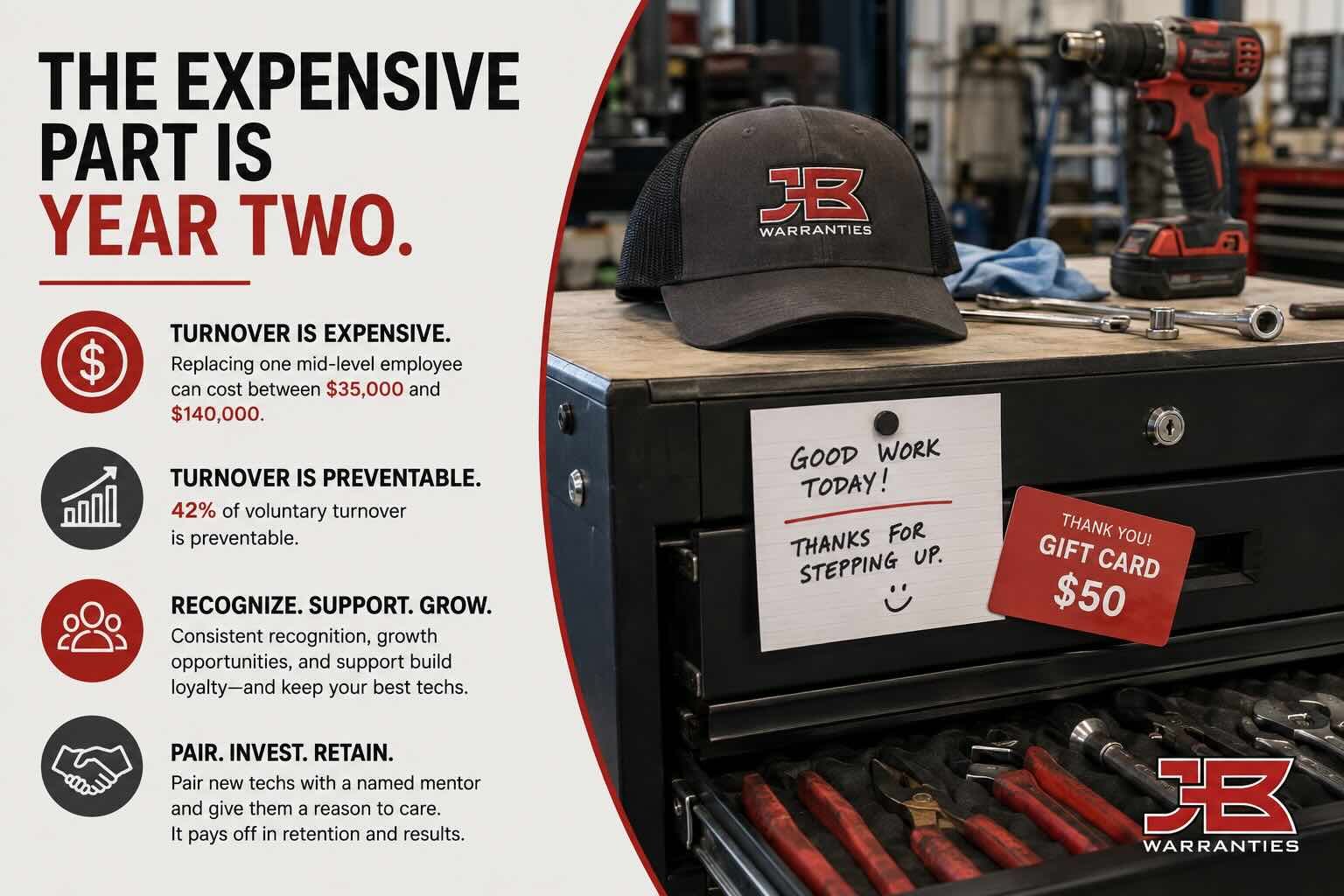
The ROI of Recognition: How a $50 Gift Card Saves $5,000 in Turnover Costs estimates the cost of replacing one mid-level employee can cost between $35,000 and $140,000. Gallup states that 42% of voluntary turnover is preventable and that consistent recognition is a proven way to help reduce it.
Deloitte provides insight into Gen Zs at work in one their "Insights" articles. Managers should stay alert to sources of stress within their teams and take flexible, practical steps to address concerns. They should consistently recognize employees’ work, offer opportunities for growth and learning, understand factors that motivate Gen Zs, and be prepared to discuss mental health support or direct employees to appropriate company resources when needed.
The mechanic of it is simple enough. Pair every new tech with a named senior tech, not a rotating cast. Give the senior tech a reason to care, whether that's a stipend or a slice of the apprentice's performance. The same retention logic applies on the plumbing side, and a guide to hiring and retaining skilled plumbers covers where those programs usually break down.
The Part Owners Skip: What You Hand a Tech to Sell
Here is a link between hiring and revenue that rarely gets drawn. A young technician's confidence in front of a homeowner is built almost entirely from the tools you give them. Put a nervous 23-year-old in a kitchen with a $9,000 estimate and no way to answer "what happens if this breaks in three years," and you get a discounted job, a second opinion, or no sale at all.
That's a training problem on the surface and a product problem underneath. An extended service agreement gives a newer tech something concrete to say at the exact moment the conversation gets uncomfortable. JB Warranties™ Extended Service Agreements cover labor where the manufacturer's warranty covers parts, with no deductibles for the homeowner and free transfers if the house sells during the coverage period. Those are three sentences a first-year tech can memorize and deliver without feeling like a salesperson.
There's a retention argument here too, and it's the one owners tend to miss. Disputes over who pays for a repair are miserable for the person standing in the customer's hallway. Rookies get that call most. They don't stay long. A clean claims process removes the worst part of a new tech's week, and what dealers get out of building JB Warranties into every job lays out how that works alongside the revenue side. For shops running ServiceTitan, JB360™ is offered free and keeps the warranty step inside the software your techs are already in, which matters more to a 24-year-old than most owners expect.
Where to Start This Month
Three moves, in order of how fast they pay back.
Post the range. Rewrite your two most-used job listings with a real pay band and a written first-year progression. This costs an afternoon.
Name the recruiter. One person owns candidate response time, and response time is measured in hours, not days. Text first.
Fix what year-one techs are handed. Whatever makes the estimate conversation hard for a rookie is also what makes them quit. Warranty backing, a script, and a senior tech who answers the phone go further than a signing bonus.
The candidates are out there in larger numbers than they've been in years. Whether they end up on your trucks or a competitor's mostly comes down to who answers first and who has an answer for what happens after year one.
Ready to add JB Warranties to your offering?
The techs you hire this fall are easier to keep when you give them something solid to stand behind.
Frequently Asked Questions
Where do I actually find Gen Z technicians to hire?
Start with the schools closest to you. Two-year HVACR program enrollment jumped nearly 29% between spring 2024 and spring 2025, so the local community college or trade school pipeline is deeper than it was even two years ago. Build a standing relationship with one instructor instead of showing up once a year at a career fair. Referrals from the younger techs already on your payroll tend to convert better than job boards.
How much do I have to pay to be competitive for a young HVAC or plumbing tech?
As documented in the information above, the Bureau of Labor Statistics puts the national median annual wage at $61,010 for HVACR mechanics and installers and $63,800 for plumbers, pipefitters, and steamfitters, both as of May 2025. Those are medians across all experience levels rather than starting pay, and your local market may sit well above or below them. Check what the two or three shops you keep losing candidates to are actually posting. Pay is rarely the only reason someone picks a shop, but it is the first filter.
Should I post the salary range in my job listing?
Yes. A listing with no number reads to a younger candidate as a listing with something to hide, and they will apply to the shop that posted one. A range also screens out people who were never going to accept your offer, which saves interview time on both sides. Several states now require pay ranges in job postings, so check your state rules before writing the ad.
How fast do I need to respond to a technician applicant?
Hours, not days. Most strong candidates in this trade are already employed somewhere else and only mildly curious about you, so the window closes quickly. Text rather than email, since a text reaches someone who is on a job site and cannot take a call. Assign response time to one named person so it does not drift between managers.
Why do my young hires quit in the first year?
Usually it is not the pay. The common causes are no visible path past the current role, no assigned mentor, and being sent in front of customers without the tools to handle hard questions. A first-year tech who cannot answer what happens if this breaks in three years learns to dread every estimate conversation. Fix the path and the support before raising the wage.
Is it worth building an apprenticeship program, or should I just hire experienced techs?
Experienced techs are scarce and expensive, and you are bidding against every other shop in your market for the same people. An apprenticeship costs more up front in supervision time but produces a tech trained in your process rather than someone else's. Owners who run both usually find the apprentice pipeline stabilizes staffing within two to three years. It only works if a named senior tech owns the training.
What does an extended warranty program have to do with hiring?
It changes what a newer tech is able to say in front of a customer. An extended service agreement covers labor where the manufacturer warranty covers parts, which gives a first-year tech a concrete answer to the question they get asked most. It also removes the repair-cost dispute that makes younger techs dread certain calls. Shops with a clean claims process spend less time defending invoices and more time booking work.

Brian Bohannan
Vice President of Sales at JB Warranties