



Every shop has a tech or two who sells service plans without trying. Homeowners trust them, the conversation feels natural, and plans get added without a hard sell. Most of what makes them good is teachable.Selling service plans becomes more consistent when that successful tech's approach becomes the team's approach. A repeatable conversation framework captures what your strongest techs already do and turns it into a process any tech can run, with room for each tech's judgment and style. Every homeowner hears the plan, tied to what the tech found in that home, delivered in the tech's own words.
Below is a five-step framework your techs can run on every call, plus what owners need in place to make it stick.
Why Offer on Every Call
Good techs read the room, and that instinct is part of what makes them good at the job. With plan offers, though, a homeowner's priorities aren't always visible from the kitchen. The retiree may have set money aside for exactly this kind of protection. The landlord may want predictable repair costs across several properties. Offering on every call lets the homeowner decide what fits.
Offering on every call doesn't mean recommending every product to every homeowner. It means presenting the options that fit that home and that equipment, explaining them clearly, and letting the customer choose.
Consistency also protects the customer relationship. A tech who presents plan options on every call delivers them as a natural part of the visit, not a last-minute pitch. Because Step 1 sets that expectation at the door, the homeowner hears it as part of the service.
For owners, the math adds up quickly. Take a hypothetical shop running 500 eligible service calls a month. Raising its attach rate from 10% to 15% adds 25 plan sales a month from calls the team is already running. No extra marketing spend, no extra trucks. Memberships add renewal revenue on top of that, and both plan types give homeowners a reason to keep calling your company.
"Service plan" can mean two products. A maintenance agreement or membership covers scheduled visits and perks. An extended service agreement protects the homeowner from covered repair costs, such as parts or labor, according to its terms. Some contractors sell one, some sell both, and the framework works either way. For building the membership side, see how to build an HVAC maintenance membership that grows revenue.
Step 1: Set Expectations at the Door
The conversation starts before you pull out the tools. A short line at arrival tells the homeowner what will happen and earns permission to share findings later:
"I'll take care of what you called about. While I'm here, I'll check the whole system, and before I leave I'll walk you through what I found and a couple of ways to keep it running."
The last sentence does the heavy lifting. It tells the homeowner that options are coming, so the plan conversation doesn't land as a surprise twenty minutes later. Techs don't need to use these exact words. What matters is that the homeowner knows a findings review is part of the visit.
Step 2: Build the Conversation Around Findings
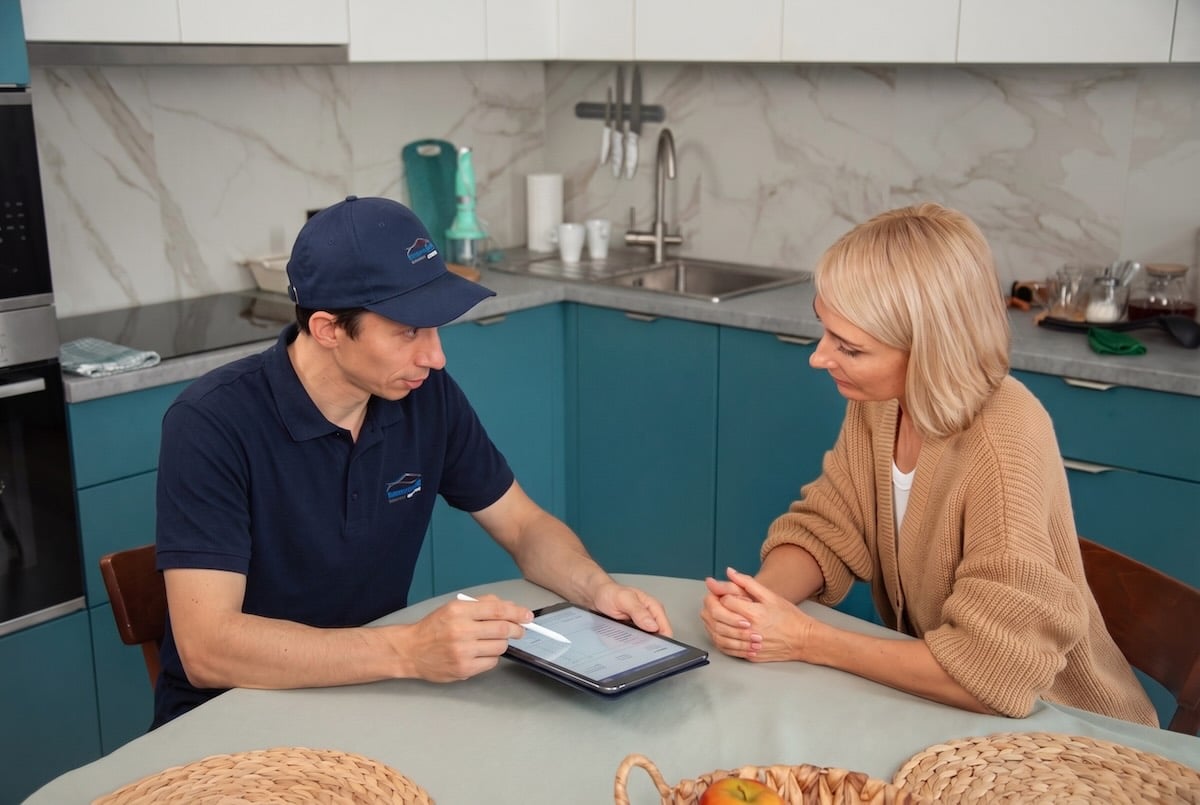
A plan offer works when it connects to something the homeowner can see. Train techs to collect a few observations on every visit, such as equipment age, component wear, or a reading trending the wrong way. A photo on a tablet does more than any brochure.
On an HVAC call, that might be a dirty blower wheel or a capacitor reading below spec. On a plumbing call, it could be sediment in a water heater or a corroded shutoff valve. Not every observation is a problem, and techs shouldn't present it as one. The goal is to show the homeowner what their system looks like today, so the plan answers a question they now care about.
For maintenance visits specifically, the fall tune-up sales playbook goes deeper on this findings-first approach.
Step 3: Present Options Before the Invoice
Timing makes a big difference. Once the invoice is on the screen, the homeowner is in pay-and-done mode. Present plan options after the findings walk-through and before the final ticket.
Give the homeowner a choice, not a yes-or-no question. If your company offers both a membership and extended coverage, the choice can be between the two:
"Based on what I found, there are two options worth a look. The maintenance membership covers your yearly tune-ups and gets you priority scheduling. The extended coverage pays for covered repairs down the road. Which matters more to you right now: staying ahead on maintenance, or protecting against repair bills?"
If you offer one product, the choice can be about the next step:
"We offer extended coverage for covered repairs on this system. Do you want to go over the coverage and cost now, or should I have the office send you the details?"
Accuracy matters as much as delivery. Techs should know what each plan covers, what it excludes, and which equipment qualifies. If a question goes beyond what they know, the right answer is "Let me have the office confirm that," never a guess.
On replacement jobs, the same moment works for bundling coverage into the proposal. If your company offers HVAC customer financing, the plan can ride along in the monthly payment conversation.
Step 4: Handle the Pause Without Pushing
Most hesitation falls into a few familiar patterns. Give techs a calm response for each and practice them in morning meetings or ride-alongs. Rehearsed responses sound natural; memorized scripts don't.
- "I need to think about it." Agree. Leave a written summary with the findings and plan options, and say when the office will follow up.
- "I never end up using these." Walk through what a typical repair on their equipment costs, using your own pricing, and what the plan would cover.
- "My system is brand new." New equipment is often the easiest time to add coverage, because extended agreements usually have a purchase window after installation. Maintenance still matters on new equipment too.
- "That sounds expensive." Take the budget concern seriously. If you offer different plan levels or payment options, explain them. Sometimes the plan isn't the right fit, and that's an acceptable outcome.
Once a homeowner clearly declines, the tech moves on. A pushy visit can cost more in reviews than a missed plan earns, and your online reputation drives the next call.
Step 5: Follow Up When the Answer Is "Not Today"
A no on the call is often a "not yet." Some homeowners want to talk it over with a spouse or check their budget first. Tag declined offers in your CRM with the options discussed and any open questions. Then have the office send a short note within a set window.
Keep the follow-up tied to the visit. "Here are the photos from Tuesday and the two plan options we talked about" gets a better response than a generic promotion. The office can also answer detailed coverage or billing questions the tech couldn't settle on site.
Adapting the Framework by Call Type
The five steps stay the same. What changes is the finding you anchor on and how long the conversation runs.
|
Repair or no-heat |
The failed part and the age of everything around it |
Coverage for the next covered repair |
|
Maintenance visit |
Wear items and readings against spec |
Membership renewal, or adding extended coverage |
|
New installation |
The investment the homeowner just made |
Coverage that starts with the new equipment |
|
Plumbing service |
Water heater age, valve condition, visible corrosion |
A plumbing service agreement or extended coverage |
|
After-hours emergency |
Fix first; share findings once the problem is solved |
A brief mention, with office follow-up for details |
What Owners Need in Place
Techs will only run the framework if the surrounding system supports it. These five owner-level decisions make the difference.
Build the offer into the workflow. Add plan options to the mobile estimate or invoice flow so presenting them is a standard step. ServiceTitan's guide to maintenance agreements suggests making membership forms mandatory on certain calls so techs know when to offer them.
Make product knowledge part of training. Techs recommend what they understand. Give them a one-page comparison of each plan's benefits, price, and exclusions. Make sure they know when to hand a question to the office.
Track offer rate and attach rate. Offer rate is the share of eligible calls where a tech presented plan options. Attach rate is the share of eligible calls that ended with a plan sold. A low offer rate points to a habit or workflow gap. A high offer rate with a lower attach rate points to product fit, pricing, or presentation, and each calls for different coaching. Use both numbers to coach, not just to rank techs against each other.
Reward the behavior you want. If you pay a spiff per plan sold, consider recognizing consistent offers too while the habit forms.
Train, then ride along. Classroom role-play helps, but techs improve fastest with feedback from real calls. The goal is a consistent customer experience, not identical scripts. The HVAC sales training post explains why tailored training outperforms generic programs.
Make the Coverage Easy to Explain
Techs pitch what they understand and trust. If the extended coverage in your plan is hard to explain, or if claims drag on, even confident techs will hesitate to offer it.
JB Warranties is North America's leading provider of Extended Service Agreements to HVAC and plumbing contractors. Plans cover all brands, with parts-and-labor or labor-only options depending on the equipment. Labor reimbursement runs up to $300 an hour, with no deductibles. Coverage transfers to a new homeowner free of charge, which gives techs one more benefit to mention.
The back office is simple too. Dealers use an online dashboard to buy agreements and file claims, and we pay claims quickly. A free literature tool creates brochures and flyers with your logo. See the HVAC extended warranty program and plumbing warranty solutions for plan details, or read the extended warranty business model guide for how coverage fits your revenue model.
Want a service plan your techs can offer on every call before the new year? Become a JB Warranties dealer and add extended coverage to the plans you already sell.
Frequently Asked Questions
When should a technician offer a service plan during a call?
After walking the homeowner through what was found and before presenting the final invoice. At that point the homeowner has context for why a plan matters, and the conversation is still part of the visit rather than the checkout.
Should technicians or a dedicated salesperson sell service plans?
For most residential calls, the technician is the right person. The tech has been in the home, has seen the equipment, and has earned the homeowner's trust. A dedicated salesperson or the office makes more sense for replacement proposals, detailed coverage questions and follow-up.
What is the difference between a maintenance agreement and an extended service agreement?
A maintenance agreement or membership covers scheduled visits and perks such as priority scheduling. An extended service agreement protects the homeowner from covered repair costs, such as parts or labor, according to the agreement's terms. Contractors may offer one, the other, or both.
What is the difference between offer rate and attach rate?
Offer rate is the share of eligible calls where a technician presented plan options. Attach rate is the share of eligible calls that ended with a plan sold. Tracking both shows whether a gap comes from inconsistent offers or from how the options are presented.
Does this framework work for plumbing contractors?
Yes. The steps are the same. Plumbing findings such as water heater age, valve condition and visible corrosion anchor the conversation the same way HVAC readings do.
Should technicians offer service plans during emergency calls?
Fixing the immediate problem comes first. Once the issue is resolved, the technician can briefly mention relevant options and offer to have the office follow up with details, since a homeowner dealing with an urgent repair may not want a longer conversation that day.

Jenna Ochoa
Vice President - Claims, JB Warranties