



Most HVAC and plumbing business owners already know extended warranties can add revenue. Fewer have looked closely at how the underlying business model actually works, and that gap quietly costs money. Understanding the mechanics helps you decide how to offer coverage, how to price it, and whether to run a program yourself or partner with a provider.
Right now, owners tend to fall into one of three camps. Some administer a warranty program in-house. Some resell coverage through a provider. And many still don't offer extended warranties at all. This guide breaks down the model so you can see where the profit comes from, what it takes to run a program well, and how to capture the upside without taking on risk you don't need.
What the Extended Warranty Business Model Actually Is
An extended warranty is not an extension of the manufacturer's warranty. It is a separate service contract. A manufacturer's warranty covers defects in the equipment for a set period, and on HVAC and plumbing systems it usually covers parts only. An extended service agreement (ESA) picks up where that leaves off, covering labor and, in many cases, parts for covered breakdowns after the OEM term ends. The Federal Trade Commission draws the same distinction in its consumer guidance: a service contract costs extra and may cover different issues than the warranty that came with the product.
That difference matters for HVAC and plumbing owners. Manufacturers have stretched parts coverage out to ten years on many systems, which leaves labor as the cost a homeowner is most likely to face, and most likely to resent. ACHR News reporting notes that contractors increasingly add longer labor terms precisely because that is where the customer's exposure now sits.
|
Feature |
Manufacturer's Warranty |
Extended Service Agreement (ESA) |
|---|---|---|
|
Provider |
Equipment manufacturer (OEM) |
Manufacturer, retailer, or third-party administrator |
|
Cost |
Included in the equipment price |
Sold separately, as an add-on |
|
Duration |
Limited term, often up to 10 years on parts |
Extends past the OEM term, commonly 5–10+ years |
|
Coverage |
Manufacturing defects, usually parts only |
Labor and/or parts for covered breakdowns after the OEM term |
|
Purpose |
Guarantee the equipment against defects |
Protect against repair costs once the OEM term ends |
|
Regulation |
Governed largely by federal warranty law |
Regulated as service contracts, mostly at the state level |
How the Model Makes Money
The economics are straightforward. A provider collects premiums upfront, pools that money across many customers, and pays claims out of the pool. Because only a share of covered systems need a major repair in any given year, premiums collected exceed claims paid in a well-run program, and the difference, after administration and reserves, is margin.
Revenue comes from a few places: premiums at the point of sale, investment returns earned on those premiums before claims arise, disciplined repair-cost management through set labor rates and parts handling, and renewals that extend the relationship. None of it requires the contractor to carry extra inventory or add truck rolls to generate the initial sale, which is part of why the model is attractive.
Risk and Pricing: What Running a Program Well Requires
Profitability depends entirely on managing risk, and this is the part owners tend to underestimate. A sustainable program needs actuarial pricing built on real failure-rate and repair-cost data, loss-ratio targets that keep claims below premiums, reserve funds set aside for future claims, and often reinsurance to absorb catastrophic losses. It also needs compliance, because extended warranties are regulated as service contracts and the rules vary from state to state, so a program operating across jurisdictions has to track each one.
This is also where in-house programs tend to break down. ServiceTitan points out that managing service contracts manually, in spreadsheets and disconnected files, is time-consuming, error-prone, and hard to scale. Layer underwriting, reserves, and multi-state compliance on top of that, and you are effectively running a small insurance company alongside your trade business.
Where You Fit, and Why Most Contractors Partner
Here is the practical question for an owner: do you want to build that machinery yourself, or capture the upside without it? The answer depends on which camp you are in.
If you administer a program in-house, the model can work, but it ties up capital in reserves, demands actuarial discipline, and puts compliance risk on your shoulders. If you resell through a provider, your biggest decision is which partner to trust. ACHR News has reported that some warranty providers went out of business years later, leaving the contractor to cover the obligations they had already sold. And if you don't offer coverage at all, you are leaving recurring revenue, customer retention, and a clear point of differentiation on the table.
This is where partnering with a provider like JB Warranties™ changes the math. JB Warranties carries the A-rated insurance backing, the reserves, and the compliance across all 50 states and Canada, so you are not the one running the insurance side. You sell the coverage, mark it up for margin, and keep ownership of the customer relationship. Plans are transferable, there are no deductibles, and claims are handled quickly, which protects the homeowner experience your reputation rides on. You can see how this works on the HVAC extended labor warranty program and plumbing extended warranty solutions pages.
The Business Case: Recurring Revenue, Retention, and Valuation
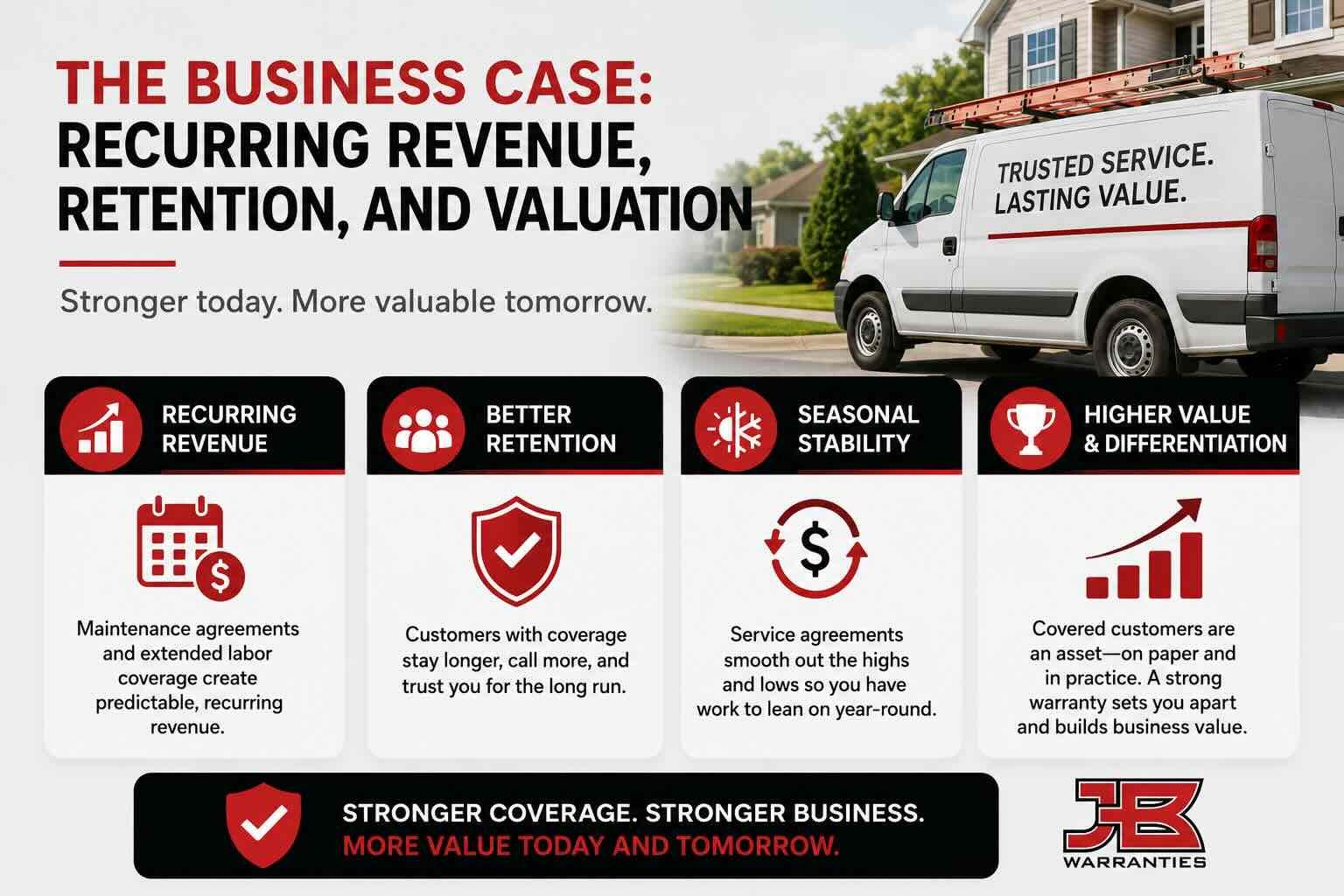
The reason to bother with any of this is that the model strengthens the core business. Contracting Business describes how pairing maintenance agreements with extended labor coverage creates recurring revenue and improves retention, a shift that matters more now that homeowners are favoring repairs over full replacements. Coverage also helps smooth the seasonal peaks and lulls every HVAC and plumbing owner knows, since service agreements give you guaranteed work to lean on when the phones go quiet.
There is also a balance-sheet angle owners often miss. ACHR News reported an insurance executive's observation that a self-insured customer can look like a liability in a business valuation, while a customer covered by a properly underwritten warranty shows up as an asset. Coverage that is backed and administered well, in other words, can make the business itself worth more. Differentiation is the everyday benefit. Offering a strong warranty signals confidence in your work and sets you apart from competitors who don't, and the Dealer Benefits page lays out how that plays out for JB Warranties dealers.
Selling It Well: Psychology and the Point of Sale
A strong program still has to be sold, and the psychology is simple and durable. Loss aversion means customers respond more to avoiding a large, unexpected repair bill than to an abstract benefit, so frame coverage as protection against that bill. Lead with peace of mind for the moment a system fails. And use the point of sale to your advantage: your technician is the trusted expert in the home, so the offer lands best during the install or service visit, when credibility is highest.
When an Extended Warranty Makes Sense, and When to Be Honest
Being straight about fit builds more trust than pushing coverage on everyone. An ESA makes the most sense on complex, higher-cost systems where a single failure can run well into four figures, on equipment a customer plans to keep for years, and with homeowners who value predictable costs over rolling the dice. For a low-cost component a customer could easily cover out of pocket, saying so earns credibility you can spend later.
Used this way, the extended warranty business model does more than add a line item. It diversifies revenue, smooths the season, deepens customer relationships, and gives your business a durable edge. The owners who win with it are the ones who understand the model and then run it efficiently, usually by letting a specialist carry the risk while they keep the margin.
That is the role JB Warranties is built to play. If you want to add transferable, no-deductible coverage backed by A-rated insurance and run it without becoming an insurer yourself, you can become a dealer and start offering it on your next install.

Frequently Asked Questions
What's the difference between a manufacturer's warranty and an extended warranty?
A manufacturer's warranty comes with the equipment and usually covers parts and defects for a set term at no extra cost. An extended warranty, or service agreement, is a separate contract you buy on top of that. It typically covers labor and parts for covered breakdowns after the manufacturer's term ends, often for five to ten years or more.
How do extended warranty companies make money?
They collect premiums upfront, pool them across many customers, and pay claims from that pool. Because only a share of covered systems need a major repair each year, well-run programs keep claims below premiums. Providers also earn investment returns on premiums before claims arise and manage repair costs through set labor rates and parts handling.
Can an HVAC or plumbing contractor run their own extended warranty program?
Some do, and the model can work in-house. But it means setting actuarial pricing, holding reserves, possibly buying reinsurance, and staying compliant with service-contract rules that vary by state. That is a lot of overhead on top of running a trade business. Most contractors capture the same upside by reselling coverage through a provider that carries the risk.
Are extended warranties profitable for contractors?
They can be. You typically mark up the coverage for margin at the point of sale, with no added inventory or truck rolls to make that sale. Beyond the direct margin, coverage drives recurring revenue, improves retention, and can even raise your business's valuation, since covered customers look stronger on the books than self-insured ones.
Are extended warranties regulated?
Yes. Extended warranties are generally treated as service contracts, and they're regulated mostly at the state level, so requirements differ across states and provinces. The Federal Trade Commission also distinguishes service contracts from manufacturer warranties in its consumer guidance. Operating across markets means tracking each jurisdiction's rules, which is one reason many contractors partner with a compliant provider.
What should I look for in an extended warranty partner?
Stability first. Some providers have gone out of business and left contractors holding the obligations they sold, so check how long the company has operated and how its plans are backed. Look for A-rated insurance backing, fast and fair claims, no deductibles, transferable plans, and compliance across the states where you work.
Do extended warranties help with customer retention?
They do. A covered customer has a reason to keep coming back to you, and a smooth claim turns a stressful breakdown into a loyalty moment. Coverage also pairs naturally with maintenance agreements, which deepens the relationship further and creates steady, recurring revenue across the slow seasons.

Jenna Ochoa
Vice President - Claims, JB Warranties