



The first hard cold snap often arrives without warning. Suddenly, the schedule fills with no-heat calls, and before noon, a technician is on a jobsite facing a failed hot-surface igniter that isn't stocked on the truck and won't be available from the supply house until later in the week.
This is the situation fall parts planning is meant to address. It's not about a perfect spreadsheet. It's about the week your team's capacity is tested, and your inventory either supports your business or leads to missed opportunities.
Stocking is often seen as just another purchasing task, handed off to whoever is available at the warehouse. In reality, it's a margin decision. The parts on the truck during the first cold snap determine how many calls your technicians can complete, how many customers are left waiting for parts, and how many may turn to a competitor in the meantime.
What a Missing Part Actually Costs You
Consider the cost of a single second trip. There's the expense of sending a technician back out, the diagnostic time already invested, and the lost opportunity to book a new call in that slot. There's also the customer who waited two days for heat and now shares that experience with others.
No reliable public benchmark exists for the cost of a second trip for residential HVAC contractors, and any unsourced figure is just a guess. What matters is your own data. Review twenty jobs from last February where a technician had to return. Multiply those return visits by your loaded hourly cost, and stocking decisions become about protecting your margin, not just managing shelf space.
Heating season increases this risk. Cooling failures are spread out over several months, but furnace failures tend to cluster in the weeks following the first freeze. That's also when supply houses are busiest and lead times get longer.
Stock What Fails in October, Not What Failed in July
Truck stock that works for the cooling season won't meet November's needs. ServiceTitan's HVAC truck inventory list, updated in March 2026, highlights the need to shift focus in winter to heating components such as flame sensors, igniters, and thermostats. It's also important to include spare heating controls and safety switches.
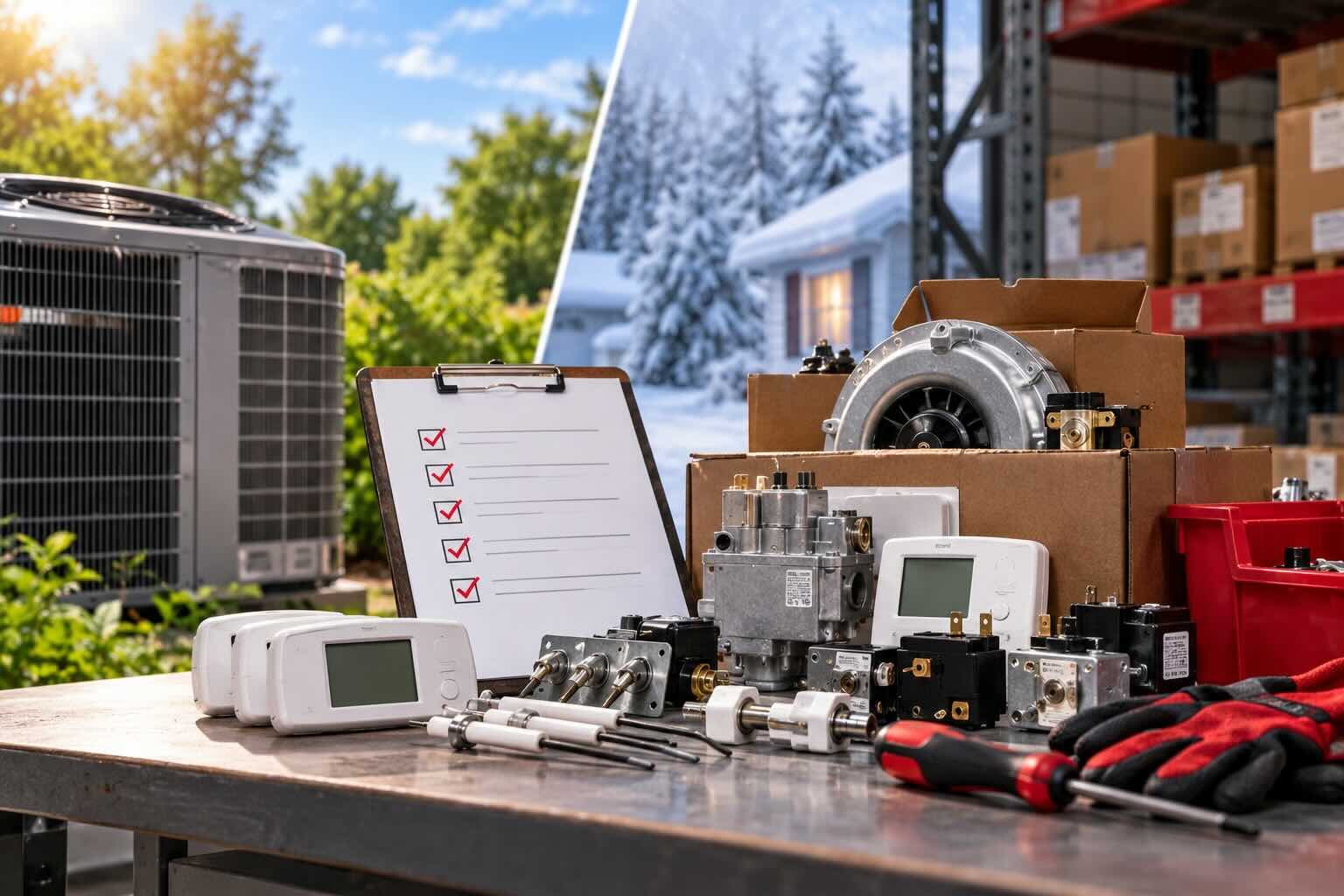
Writing for Contracting Business last year, Parts Town's John Warpinski makes a related point owners tend to underweight: carrying multiple sizes and variations of a component turns a stocked part into a completed repair. One universal igniter in one configuration is not coverage. It's a coin flip.
Let your own call history set the levels
Industry checklists can help identify categories, but they can't determine quantities for your business. Your mix of equipment age, brands, and climate is unique.
Review invoices from the last two heating seasons and count what your technicians actually replaced between October and February. Sort these items by frequency. The top fifteen should make up your heating-season truck stock. Anything purchased only once in two years should stay at the warehouse, not on the van. Most field service platforms make this quick, replacing guesswork with real data.
Warehouse depth is a different question
Truck stock is for same-day calls. Warehouse stock is for situations when a cold snap causes a surge in demand for a specific part across your service area. These are separate decisions with different quantities. Combining them into one order can tie up capital in the wrong inventory.
Buy Before the Next Price List Lands
Parts pricing has been moving all year steadily, and fall is a poor time to be surprised by it. ACHR News publishes a running monthly price increase list, and the September 2026 edition reported increases ranging from 5% to 15%, including a Bard service parts adjustment effective September 1 and a Jones Stephens increase of 5% to 15% by product group effective September 3.
Those numbers reflect cost pressure you should understand before you negotiate. ACHR News reported in July on new Section 301 tariffs that took effect July 24, 2026, applying a 10% duty to countries that adopted forced-labor import prohibitions and 12.5% to those that have not. China sits in the higher tier and is named in that piece as a major source of compressors and control boards. HARDI senior research analyst Joey James offered a real caveat in that piece, noting that because most HVACR equipment and components run through Section 232's steel, aluminum, and copper derivative provisions, "a large share of the sector's imports doesn't touch this new tariff at all."
There are two practical takeaways. First, buying your highest-volume heating parts before a posted price increase is a direct way to protect your margin. Second, since tariff and pricing conditions have changed month to month in 2026, always confirm current pricing with your distributor before placing an order.
Your Distributor Relationship Is Part of the Inventory Plan
A stocking strategy depends on the supply house being able to restock what you use. Check this with your distributor before December.
Brian O'Mahony, president of Carrier Enterprise North America, wrote in ACHR News this month that 31% of HVAC contractors expect same-day availability of essential warranty parts, a finding also verified by The HVAC Industry Journal. For years, many warehouses relied on veteran employees' memories and longstanding practices. Standardizing warehouse inventory management can improve inventory accuracy. Ask branch managers about their cutoff time for same-day pickup and whether they will reserve your top-moving parts under your name. Strong supplier relationships are an asset in meeting client needs.
Ask these questions now. By January, your distributor will be too busy to discuss details.
Count It, Don't Just Buy It
Buying the right parts but tracking them poorly leads to the same result as not buying at all: a technician on a job without the needed part. ServiceTitan's guide to HVAC inventory management covers the basics: regular audits, clear procedures for recording usage and returns, and a few key metrics to monitor. Shrinkage, turnover, and out-of-stock rate are the most useful for owners. The guide lists these metrics but doesn't provide benchmarks, so use them as a framework, not a scorecard.
Set your own baseline this month and compare it next spring. Shops that have done this warn that counts only stay accurate if recording usage is easier than skipping it. If your process relies on a technician remembering to write something down after a long day, it won't be reliable. Make recording parts usage part of the invoice process.
Fall heating tune-ups often reveal aging systems before they fail. Use those inspection findings to plan your parts inventory. If a technician notes several marginal inducer motors during a week of tune-ups, that's a clear signal for what to order.
The Cost You Can't Stock For
One gap stocking alone can't solve. Even with the right control board on the truck, who pays for the labor to install it can still cause issues.
Manufacturer warranties typically cover parts, not labor. Homeowners are often surprised by labor charges a year or more after installation. That surprise can lead to discounts, unbilled callbacks, or negative reviews that impact future business.
An extended service agreement addresses this gap. JB Warranties™ Extended Service Agreements cover labor when the manufacturer's warranty covers only parts. Homeowners pay no deductible, and coverage transfers for free if the home sells during the coverage period. For business owners preparing for heating season, this turns an unpredictable labor expense into a fixed cost and gives technicians a clear answer to the most common warranty question. The HVAC extended warranty program explains how coverage attaches to a job, and the dealer benefits page details claims and reimbursement, which is critical when a covered failure happens during your busiest week.
Run This Before the First Freeze
Here are three steps, listed by how quickly they pay off.
Rebuild your truck stock using your own data. Review what your technicians replaced from October through February, rank those items, and stock the top fifteen. Use your own numbers before relying on a generic list.
Secure pricing on your highest-volume parts. Ask your distributor about any posted fourth-quarter increases and buy ahead for your top SKUs. Always confirm current pricing before placing an order.
Address the labor gap. Having parts available keeps your schedule on track. Warranty coverage protects your margin on repairs you can't schedule in advance.
None of this is complicated. It's just work that rarely feels urgent until it's too late.
Frequently Asked Questions
What HVAC parts should be on the truck for heating season?
The seasonal swap matters more than the total count. Flame sensors, hot-surface igniters, and thermostats are the ones that turn a no-heat call into a same-visit repair, and spare heating controls and safety switches belong on the truck alongside them. Carry more than one configuration of the parts that come in variations, because a universal igniter in the wrong style is the same as no igniter. Cooling-heavy stock can move back to the warehouse once the changeover happens.
How do I know how many of each part to stock?
Use your own invoices rather than a generic checklist. Pull the last two heating seasons, count what your techs actually replaced between October and February, and rank the line items by frequency. The top fifteen are your heating-season truck stock. Anything you replaced once in two years belongs at the warehouse, not riding around in a van all winter.
Should truck stock and warehouse stock be planned separately?
Yes, because they answer different problems. Truck stock is what lets a tech finish a call on the first visit. Warehouse depth is what covers a run on one specific part when a cold snap takes out dozens of control boards across your service area in the same week. Ordering both off a single list is how shops end up with working capital sitting in the wrong SKUs.
Should I buy HVAC parts ahead of announced price increases?
For your highest-volume items, usually yes. A posted increase on a part you buy fifty times a winter is straightforward arithmetic, and buying ahead of it costs you only the carrying cost of holding the stock a few extra weeks. It makes far less sense for slow movers, where tied-up cash outweighs the savings. Confirm the current list with your distributor before committing a purchase order, since pricing has been moving month to month.
Are HVAC parts prices still rising in 2026?
They have been moving through the year. ACHR News publishes a monthly price increase list, and its September 2026 edition reported manufacturer increases ranging from 5% to 15%, including adjustments to service parts and fittings taking effect early in the month. New Section 301 tariffs that took effect July 24, 2026 added cost pressure on imported components, though HARDI has noted that much of the sector's imports fall under separate provisions and are not affected by that particular tariff. Pricing conditions have changed repeatedly this year, so verify anything you read against your own distributor's current pricing.
How do I keep an accurate parts count without slowing my techs down?
The count stays accurate only when recording a part is easier than skipping it. Tie the parts pull to the invoice inside whatever field service software your techs already use, so the record happens as part of the job rather than as paperwork afterward. Back that with regular cycle counts and a written procedure for usage and returns. A process that depends on someone remembering at the end of a long day is not a process.
What does an extended warranty have to do with parts inventory?
Inventory solves availability, not cost exposure. Manufacturer warranties cover the part itself and say nothing about the labor to install it, which is the bill that surprises a homeowner a year or two after the job. An extended service agreement covers that labor, which turns an unpredictable expense into a known one and gives a technician a clear answer at the estimate. It also removes the who-pays argument that tends to land during the busiest week of heating season.
Ready to add JB Warranties to your offering?
The right part on the truck saves the visit. The right labor coverage saves the margin.


Nick Ahrens
National Account Manager