



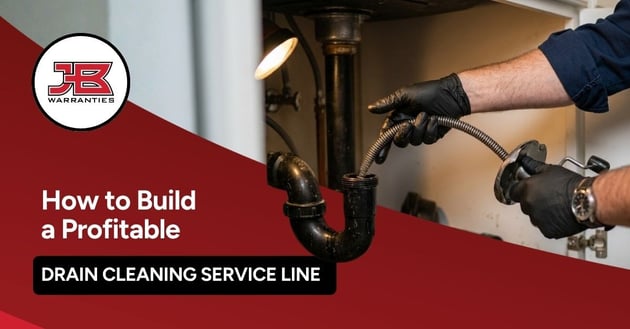
Most plumbing companies already send technicians out on drain calls. Far fewer treat drain cleaning as its own service line, with its own pricing, its own marketing, and its own profit target.
That gap is an opportunity. Drain cleaning has low material cost, fast turnaround, and high repeat-customer potential, which makes it one of the more efficient ways to add margin without adding trucks.
Why Drain Cleaning Deserves Its Own Line Item
When drain work gets buried inside "general plumbing repair," owners lose visibility into how the service actually performs. You can't price it right, staff it right, or market it right if it's not tracked separately.
Plumbing businesses overall should be aiming for gross margins in the 60–62% range to support healthy 17–20% net margins, according to ServiceTitan's industry benchmark work with plumbing profitability expert Bill Powers. Drain cleaning, done well, tends to run above that line-wide average because labor is the dominant cost and materials are minimal — though the exact margin will vary by market and equipment used, so treat any specific percentage as an illustrative estimate rather than a guaranteed number for your business.
Separating drain cleaning into its own tracked service line lets you see, department by department, whether it's actually pulling its weight — the same tiered approach ServiceTitan recommends for any plumbing department: assess current performance, then optimize pricing and staffing before scaling.
.jpeg?width=1376&height=768&name=Drain_cleaning_with_hands_202607200954%20(1).jpeg)
Step 1: Build a Real Pricebook for Drain Work
Flat-rate pricing removes the guesswork for both the tech and the customer. A technician who has to build a custom quote on every drain call is slower, less confident, and more likely to underprice the job.
At minimum, your drain cleaning pricebook should separate:
- Standard drain snaking (kitchen, bath, floor drain)
- Hydro-jetting for grease or root intrusion
- Camera inspection add-on
- Main line vs. branch line service
- Emergency/after-hours premium
Licensed plumber labor typically runs between $45 and $150 per hour depending on experience and location, and commercial drain work often commands a premium because of code and access complexity. Build your drain rates off your actual labor cost, not a competitor's advertised price.
Step 2: Train Techs to Sell the Second Visit, Not Just Clear the Clog
A cleared drain today doesn't prevent the same clog in eighteen months. That's the opening for a maintenance conversation, but it only works if techs are equipped to have it without sounding like they're upselling for the sake of upselling.
ServiceTitan's plumbing sales research points to giving techs pre-approved maintenance agreement templates they can present and close on the spot, rather than following up later, since signed-in-the-field agreements convert far more often than anything left for a callback. For drain cleaning specifically, that usually means:
- An annual or semi-annual drain maintenance plan
- A camera inspection bundled into the second visit
- A root-treatment or descaling add-on for older cast iron lines
Field techs are the group most likely to feel awkward pitching this, so the script matters as much as the offer. Keep the pitch to one clear sentence tied to what the customer already saw: the buildup on the camera, the age of the pipe, the frequency of past clogs.
Step 3: Market Drain Cleaning as Its Own Service, Not a Subcategory
Homeowners search for "drain cleaning near me" as its own intent — they're rarely searching "plumber" when a drain backs up. That means your website, your Google Business Profile, and your local ads should treat drain cleaning as a standalone service page, not a bullet point under "plumbing services."
Seasonal promotions work particularly well here. Grease buildup peaks around the holidays; root intrusion peaks in spring. A dedicated drain cleaning landing page also gives you a natural place to mention any labor warranty coverage that applies to the work, which reinforces trust at the exact moment a homeowner is deciding between three quotes.
Step 4: Protect the Work You Just Sold
A profitable drain cleaning line still has to survive callbacks. If a customer's drain clogs again three weeks after a paid service call, that's an unbilled truck roll eating into the margin you just built.
This is where a labor warranty on the work itself changes the math. Instead of absorbing every recall as a cost of doing business, the labor and — depending on the plan — parts are covered, which protects both the margin on the original job and the customer relationship. It also gives techs something concrete to point to when they're having that maintenance-plan conversation: the work is backed, not just completed.
JB Warranties structures extended service plans around exactly this kind of recurring, high-frequency plumbing work, so the coverage lines up with how drain cleaning actually gets sold and re-sold over a customer relationship.
Step 5: Track the Numbers Separately, Every Month
Once drain cleaning is priced, staffed, and marketed as its own line, close the loop by reviewing it that way too. At minimum, track monthly:
- Total drain cleaning revenue
- Number of completed drain jobs
- Average ticket per drain job
- Callback rate on drain work
- Maintenance plan attach rate
If average ticket or attach rate is flat month over month, that's a training or pricing problem, not a demand problem — drain cleaning demand is remarkably consistent year-round.
The Bottom Line for Owners
Drain cleaning already exists inside most plumbing businesses. The revenue opportunity comes from treating it as a deliberate, tracked, warrantied service line instead of a catch-all repair category. Price it on real labor cost, train techs to offer the second visit, market it on its own, and back the work so a callback doesn't erase the margin.
Ready to back your drain cleaning work with a plan built for recurring plumbing service?
See Plumbing Warranty Benefits →
Protect the margin on every drain job you sell, not just the ones that go right the first time.
Frequently Asked Questions
How much should I charge for drain cleaning as a standalone service?
Base your price on your actual labor cost, typically $45-$150 per hour depending on your market and technician experience, plus a margin target in line with your overall plumbing department goals. Avoid copying a competitor's advertised price without knowing their cost structure.
Should drain cleaning be tracked separately from general plumbing repair?
Yes. Bundling it into general repair hides whether the service is actually profitable. Tracking revenue, average ticket, callback rate, and maintenance plan attach rate separately lets you make pricing and staffing decisions based on real performance instead of a guess.
How do I get techs comfortable offering a maintenance plan after a drain job?
Give them a pre-approved, simple template they can present and close on the spot, tied to something the customer already saw, like camera footage or pipe age. A one-sentence pitch tied to visible evidence converts better than a generic upsell script.
What's the difference between snaking and hydro-jetting for pricing purposes?
Snaking clears a localized clog and is typically the lower-cost, faster service. Hydro-jetting handles grease buildup or root intrusion across a longer line and requires more equipment and time, which should be reflected in a meaningfully higher price tier in your pricebook.
Does a labor warranty actually help with drain cleaning callbacks?
It shifts the cost of a legitimate callback off your bottom line instead of eating into the margin on the original job. It also gives technicians a concrete talking point when discussing maintenance plans, since the work is positioned as backed rather than just completed.
Is drain cleaning demand seasonal?
It's more consistent than most plumbing work, though grease-related clogs tend to spike around the holidays and root intrusion often peaks in spring. Because demand holds up year-round, it's a reliable line to build marketing and staffing plans around.
What's the biggest mistake owners make when adding drain cleaning as a service line?
Treating it as a subcategory of general plumbing instead of its own priced, marketed, and tracked service. That makes it nearly impossible to tell whether the work is actually contributing to profit or just filling a truck's schedule.

Tommy Cue
Vice President of Strategic Partnerships at JB Warranties