



Phones don't ring the way they used to. Homeowners search before they call, compare before they book, and read reviews before they ever pick up the phone. For HVAC contractors, that shift means the old playbook of waiting for referrals and seasonal walk-ins leaves real revenue on the table.
Why HVAC contractors are turning to PPC to fill the schedule
PPC marketing for HVAC contractors solves that problem directly. You pay only when someone clicks your ad, and your business appears at the top of Google the moment a homeowner searches "emergency AC repair" or "furnace replacement near me." It is the most predictable lead source available to a contractor today, and it works alongside everything else you're already doing.
This post breaks down how HVAC PPC actually works, what to spend, how to measure it, and how to use your warranty offering to close more of the leads it brings in.
Quick answer: what HVAC PPC delivers
- Immediate visibility. Search ads can run within hours of launch, not months like SEO.
- High-intent leads. You appear in front of homeowners actively searching for service.
- Budget control. Set daily caps, pause campaigns when you're booked, scale during peak season.
- Measurable ROI. Every click, call, and conversion is tracked.
- Local precision. Target only the ZIP codes you actually serve.
What HVAC PPC is and why it works
Pay-per-click advertising puts your business at the top of the search results page for the keywords you choose. You bid against other contractors for placement, and Google charges you only when someone clicks.
For HVAC, this matters because the buying window is short. A homeowner whose AC quits on a 95-degree afternoon isn't shopping around for a week. They search, they call the first three contractors who look credible, and they book the one who answers. PPC puts you in those first three results.
The two ad formats that matter most for HVAC contractors are Google Search Ads and Google Local Services Ads (LSAs). LSAs appear at the absolute top of the search results, even above traditional PPC ads, and the green "Google Guaranteed" badge increases trust and click-through rates by 219%. That trust signal alone is worth pursuing for contractors in markets where homeowners are skeptical of unknown providers.
The key difference between the two:
|
Feature |
Google Search Ads |
Google Local Services Ads (LSAs) |
|
Cost model |
Pay per click (CPC) |
Pay per lead (PPL) |
|
Placement |
Top of search results, below LSAs |
Very top of search results |
|
Trust signal |
Ad extensions, reviews, location |
"Google Guaranteed" badge |
|
Control |
High control over keywords and copy |
Less direct control; Google matches leads |
|
Best for |
Driving traffic and capturing intent |
Generating direct calls from qualified leads |
Most contractors should run both. LSAs capture the highest-intent calls. Search Ads give you more control over messaging and let you target specific service categories, like heat pump installs or commercial maintenance, where a custom landing page outperforms a generic LSA listing.
The blueprint for a campaign that actually pays back
A successful PPC campaign comes down to four things: keywords, ad copy, landing pages, and bidding strategy. Skip any one of them and the budget bleeds.
Keyword selection: where most budgets die
Keyword research is the foundation. The wrong keywords burn through your daily budget on clicks from job seekers, DIYers, and tire-kickers who will never book. The right ones bring in homeowners ready to hire.
Focus on three keyword types:
- Transactional keywords signal intent to hire. Examples: "AC repair near me," "furnace installation cost," "emergency HVAC service."
- Local intent keywords include a city name or "near me." These convert at much higher rates than generic terms because they pull in homeowners who already know what they want and where they need it done.
- Negative keywords are the terms you actively exclude. Add "jobs," "DIY," "how to," "free," "Reddit," and competitor names you don't want to bid against.
Investing your budget toward unbranded search terms like "a/c repair near me" rather than spending the majority on your business name can help increase Google hits. People searching your business name will find you anyway. The growth comes from giving customers an easy way to book online, responding as quickly as possible, and following up automatically.
Ad copy that earns the click
Your ad has roughly two seconds to convince a homeowner you're the right call. Lead with your strongest differentiators:
- Hours and response time ("24/7 emergency service," "same-day appointments")
- Licensing and trust signals ("Licensed, bonded, insured," "BBB A+ rated")
- Warranty or guarantee language ("100% satisfaction guarantee," "extended labor warranty included")
- A clear, action-oriented CTA ("Schedule service now," "Get a free quote")
Warranty coverage in particular is an underused angle in HVAC ad copy. Most ads in the space lead with price or speed. An ad that promises extended labor protection at no extra cost to the homeowner stands out, and it gives your CSR a stronger close on the phone.
Landing pages: where the click becomes a customer
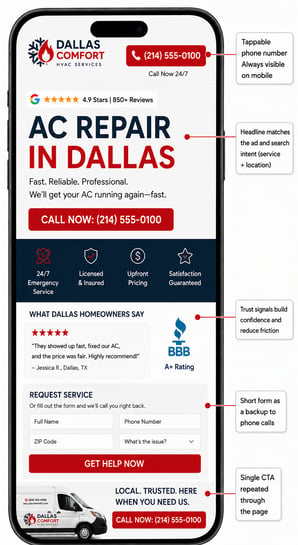 Your ad gets the click. Your landing page gets the customer. The single most common mistake HVAC contractors make is sending every PPC click to the homepage. That homepage was built to introduce your full business, not to convert one specific search intent.
A click on an "AC repair Dallas" ad should land on a page that says "AC repair in Dallas" at the top. That match between search query, ad copy, and landing page headline is what Google calls relevance, and it directly affects how much you pay per click. Stronger relevance lowers your costs.
Essential landing page elements:
- A headline that mirrors the ad and includes service plus location
- A phone number large and tappable at the top, above the fold on mobile
- Trust signals: reviews, certifications, BBB badge, warranty information
- A short form (name, phone, ZIP, problem description) as a backup to the call
- A single, contrasting CTA button repeated through the page
Mobile speed matters more than almost anything else. If the page takes longer than three seconds to load on a phone, you've lost a meaningful share of clicks you already paid for.
Budget and bidding
This is the section every contractor wants a clean number for, and the honest answer is that it varies enormously by market. A rural HVAC contractor in a low-competition market might pay $4 per click. A contractor in a major metro might pay $25 or more for the same keyword.
One useful data point: an HVAC company pays $95 for a Google Local Service Ad in a large metro area call or a click on a Google Search Ad, and the homeowner then calls and books a winter tune-up. That example gives you a realistic sense of what a single qualified contact can cost in a competitive market.
The general guidance most agencies offer is to budget 7–10% of revenue toward marketing, with PPC making up a meaningful portion of that. Note: those percentages are widely repeated in the industry but I can't tie them to a primary source from JBW's approved publications, so treat them as a starting framework rather than a benchmark.
Whatever the starting number, structure it this way:
- Set a daily cap you can absolutely afford to lose for the first 30 days
- Run manual bidding first so you can see what every dollar buys
- Switch to Google's smart bidding only after you have 30–60 days of conversion data to feed it
- Adjust seasonally — heavier on AC in summer, heat in winter, maintenance in shoulder months
Measuring what matters
Launching a campaign is the easy part. The contractors who win with PPC are the ones who treat it like a system that gets tuned weekly, not set and forgotten.
The metrics that actually matter:
- Click-through rate (CTR): how often people who see your ad click it
- Conversion rate: clicks that turn into calls or form submissions
- Cost per lead (CPL): total spend divided by qualified leads
- Return on ad spend (ROAS): revenue generated for every dollar spent
- Booked job rate: the percentage of leads your CSR actually converts to scheduled work
Sometimes the PPC program may be the perfect ad campaign, however, the CSR isn't trained to handle the calls. The CSR was not able to convert the lead to scheduled work. Each part of the process - phone handling, pricing, tech conversion, and follow-up cadence - is important and must each be successful for the marketing program to be a success.
Call tracking is non-negotiable. Without it, you have no way to know which ads, keywords, or landing pages are producing the calls that actually become jobs. CallRail, CallTrackingMetrics, and ServiceTitan all integrate cleanly with Google Ads.
Common mistakes that waste budget
- Using broad, unfocused keywords that attract researchers instead of buyers
- Only marketing during peak season
- Skipping negative keywords and burning spend on job seekers, DIYers, and competitors
- Sending all traffic to the homepage - instead of using the landing page with a click-to-call button
- No conversion tracking, so you can't tell what's working
- "Set and forget" management while competitors optimize weekly
- Inconsistent messaging between ad copy and landing page
How PPC and SEO work together
PPC and SEO are not competing channels. PPC gives you immediate leads and real performance data. SEO builds the long-term organic traffic that compounds over years.
Run them together. The keywords that convert in your PPC campaigns are the same ones worth targeting with SEO content. The ad copy that earns the highest CTR tells you what messaging resonates with homeowners in your market, which directly informs your service pages. By the time SEO catches up, you'll have years of data telling you exactly what to write.
Where extended warranties fit into your PPC strategy
Every contractor running PPC is competing on the same ground: price, speed, reviews. The contractor who adds something the others don't gets the call.
Including extended labor warranty coverage in your ad copy and on your landing pages does two things. It gives the homeowner a reason to choose you over the next contractor on the list, and it gives your tech or CSR a stronger close at the kitchen table. A 10-year labor warranty included on a new install is a meaningful differentiator in markets where every competitor is offering "free estimates" and "fast service."
If you're already running PPC and not seeing the close rate you want, the leads aren't the problem. The offer is.
You can learn more about how an HVAC Extended Warranty Program gives contractors a built-in differentiator on every job.
Frequently Asked Questions
How much should an HVAC contractor budget for PPC each month?
Budgets vary widely by market. Smaller contractors in less competitive areas often start between $1,500 and $2,500 per month, while contractors in major metros may spend $10,000 or more. The standard guidance is to allocate 7–10% of annual revenue to marketing overall, with PPC making up a meaningful portion. Start with a daily cap you can afford to lose for 30 days, then scale based on cost per booked job.
Are Local Services Ads (LSAs) better than regular Google Search Ads?
They serve different purposes. LSAs appear above traditional search ads, use a pay-per-lead model, and display the Google Guaranteed badge, which is a strong trust signal for homeowners. Search Ads give you more control over keywords, copy, and landing pages. Most successful HVAC contractors run both. LSAs capture the highest-intent calls, and Search Ads let you promote specific services and offers.
How long before HVAC PPC ads start generating leads?
Search Ads can begin running within hours of launch and produce clicks the same day. LSAs typically take one to two weeks to clear Google's verification process. Meaningful conversion data, the kind you can use to optimize bidding and budget, takes 30 to 60 days. Don't make major changes in the first two weeks beyond fixing obvious mistakes.
Why are my PPC leads not converting to booked jobs?
The lead source is rarely the problem. Most often it's a disconnect between marketing and operations. Your CSR's phone-handling, your pricing, your speed of response, and your follow-up cadence all decide whether a PPC lead becomes a job. Track booked job rate alongside cost per lead. If leads are coming in but jobs aren't, audit the call recordings before adjusting the campaign.
What are negative keywords and why do they matter?
Negative keywords are terms you tell Google to exclude from your campaigns. Without them, your ads can show up for searches like "HVAC jobs," "DIY furnace repair," or "free AC service," and you pay for those clicks. A strong negative keyword list usually saves contractors wasted spend in the first month. Common negatives include jobs, careers, DIY, free, Reddit, and competitor brand names.
Can I run PPC myself or do I need to hire an agency?
Both work, depending on your time and learning curve. In-house management can succeed if someone on staff can dedicate 5–10 hours per week to monitoring, testing, and optimization. Agencies bring experience and tools but charge a management fee, typically 7–10% of annual revenue on digital ads. Whichever route you choose, demand transparent reporting on cost per lead and cost per booked job, not just cost per click.
How does an extended warranty program help my PPC ads convert better?
Most HVAC ads compete on the same three things: price, speed, and reviews. Adding an extended labor warranty gives homeowners a real reason to choose you. It also gives your CSR and your techs a stronger close on the phone and at the kitchen table. Featuring warranty coverage in ad copy and on landing pages creates differentiation that doesn't require lowering your price.
Ready to give every PPC lead a stronger reason to book?
Adding JB Warranties to your PPC campaigns gives homeowners a built-in reason to choose you over the competition, and gives your team a stronger close on every call.


Matt Cosby
Director of Marketing