



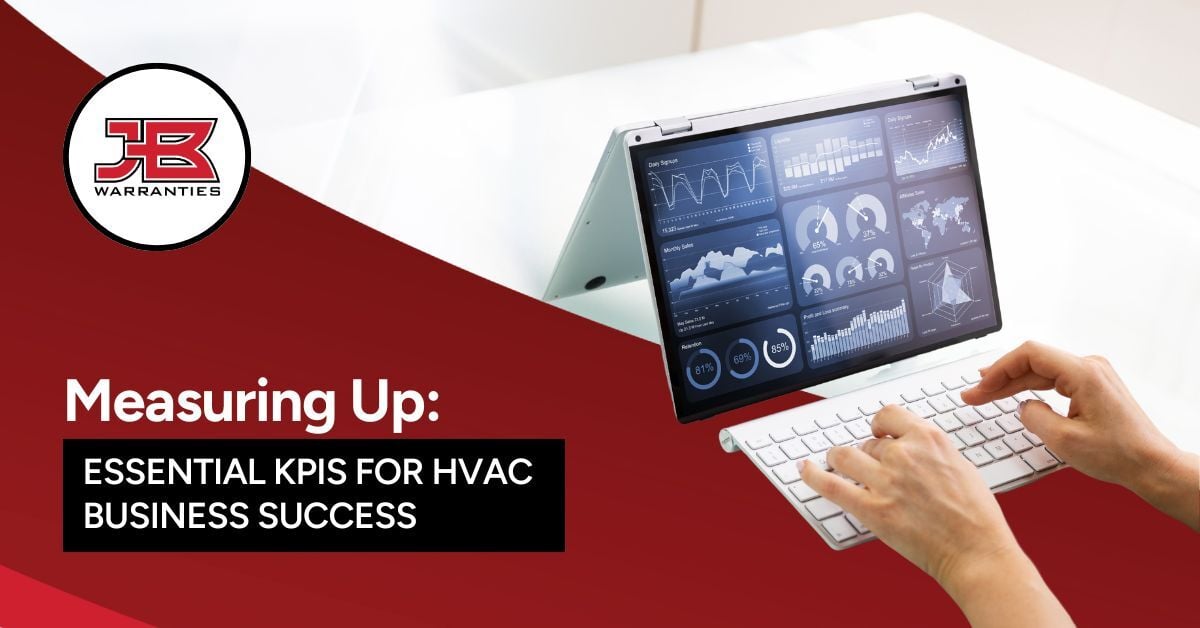
Think of your financial KPIs as the vital signs of your business. Just like a doctor checks your pulse and blood pressure, these metrics tell you whether your company is healthy, struggling, or somewhere in between.
Sales Revenue is your business's heartbeat - the total income from all your services and products. But here's the thing: you can't just look at the total and call it a day. Smart contractors dig deeper into the patterns. Are you seeing those familiar spikes when everyone's air conditioner dies in July? What about the winter rush when heating systems give up during the coldest week of the year?
Understanding these seasonal trends helps you plan for the slower months and make the most of your busy periods. If you notice installations always drop in spring and fall, that's your cue to focus on maintenance contracts and build up that steady, recurring revenue.
Gross Margin reveals how much profit you're making before all those overhead costs start eating into your earnings. The math is straightforward: take your sales revenue, subtract what it costs to provide the service, then divide by sales revenue and multiply by 100. Industry experts suggest aiming for 30% fixed costs to keep your business profitable.
When your gross margin starts looking thin, it's usually telling you one of three things: your pricing needs work, your team isn't as productive as they could be, or you're burning through materials inefficiently. On the flip side, a healthy margin gives you breathing room to invest in better equipment, training, or marketing that drives future growth.
Operating Costs are those sneaky expenses that can quietly drain your profits if you're not watching. We're talking about everything from truck maintenance and fuel to office supplies and software subscriptions. The contractors who stay profitable are the ones who regularly audit these costs and look for ways to negotiate better deals or streamline their operations.
Here's something that might surprise you: 32% of commercial energy costs go toward space heating and air conditioning. That's a massive opportunity for contractors who can help businesses slash these costs through efficient systems and regular maintenance.
Cost of Goods Sold (COGS) and your Profit and Loss calculations complete the financial picture. COGS includes all the direct costs of providing your services - parts, materials, and direct labor. When you subtract both your fixed costs (rent, insurance, salaries) and variable costs (parts, fuel, overtime) from your gross profit, you get the real story of your business's financial health.
For contractors, offering finance solutions can be a game-changer. When you can provide financing options, you remove one of the biggest barriers to closing those high-value deals.
Critical Operational KPIs to Boost Efficiency
Your operational KPIs are where the rubber meets the road. These metrics show you how efficiently your business runs day-to-day, and they directly impact both your bottom line and your customers' satisfaction.
First-Time Fix Rate (FTFR) might be the most important operational metric you can track. It measures how often your technicians solve problems on their first visit. Calculate it by dividing the number of jobs fixed on the first visit by your total jobs, then multiply by 100. Anything above 80% is considered excellent in our industry.
Why does this matter so much? Picture this: it's the middle of summer, and a customer's AC just died. They're hot, frustrated, and need help now. When your technician can fix the problem on the first visit, you save money on return trips, reduce wear and tear on your vehicles, and create a customer who's likely to sing your praises to their neighbors.
Technician Productivity tells you how much of your team's time is spent on billable work versus everything else - travel, paperwork, waiting for parts, or dealing with scheduling issues. If one of your technicians works 40 hours but only bills 30 hours to customers, their productivity is 75%.
This metric is crucial because disengaged employees cost organizations over $8 trillion annually in lost productivity. By tracking productivity, you can spot which technicians might need additional training or support, and which ones are ready for more challenging assignments. Highly engaged employees can increase profitability by 21% or more.
Average Response Time measures how quickly your team responds to service requests. In the HVAC world, response time can make or break customer relationships. When someone's furnace quits working on a 10-degree night, every minute feels like an hour.
Fast response times give you a competitive edge and often let you charge premium rates for emergency services. More importantly, they show customers you take their comfort seriously and help build the trust that leads to long-term relationships.
To boost these operational Key Performance Indicators for HVAC Companies, focus on optimizing your scheduling and dispatching. Use GPS tracking to cut down travel time between jobs, make sure your technicians have the right parts and tools before they leave, and create standard operating procedures that help everyone work more efficiently.
Customer-Focused & Marketing KPIs for Sustainable Growth

Your customer and marketing KPIs determine whether your business will be around for the long haul. These metrics help you understand not just how many customers you have, but how loyal they are and how effectively you're bringing in new ones.
Customer Retention Rate measures the percentage of customers who stick with you over time. Here's the formula: take your customers at the end of a period, subtract any new customers you gained, divide by the customers you started with, then multiply by 100. So if you started with 100 customers, gained 20 new ones, and ended with 110, your retention rate is 90%.
This metric is pure gold because keeping existing customers costs way less than finding new ones. Plus, loyal customers tend to spend more over time and become your best source of referrals. If your retention rate starts dropping, it's usually a sign of problems with service quality, pricing, or how you're communicating with customers.
Net Promoter Score (NPS) cuts through the noise to gauge real customer satisfaction. You ask one simple question: "How likely are you to recommend our company to friends or family?" Customers rate their likelihood from 0 to 10. Those who score 9-10 are your promoters, 7-8 are neutral, and 0-6 are detractors. Your NPS is the percentage of promoters minus the percentage of detractors.
For example, if 60% of your customers are promoters and 20% are detractors, your NPS is 40. An NPS above 50 is considered excellent, while anything above 70 is world-class. This metric helps you identify your biggest fans and understand what drives customer loyalty.
Lead Conversion Rate tracks how many of your leads actually become paying customers. If you have 100 leads and 20 become customers, your conversion rate is 20%. This metric helps you evaluate both the quality of your leads and how effective your sales process is.
Advertising ROI measures how much revenue you generate for every dollar spent on marketing. The formula is simple: divide your revenue from ads by your advertising costs, then multiply by 100. If you spend $1,000 on ads and earn $3,000 in revenue, your ROI is 300%.
Too many HVAC companies waste money on advertising because they don't track ROI properly. By measuring each campaign separately, you can figure out which marketing channels work best and put your budget where it'll do the most good.
One powerful way to improve both customer retention and satisfaction is by offering value-added services. An HVAC Extended Warranty Program for Contractors can boost customer satisfaction by giving them peace of mind while creating an additional revenue stream for your business.
Putting Your KPI Data into Action

Here's the thing about Key Performance Indicators for HVAC Companies - they're only as good as the actions you take based on what they tell you. Think of your KPIs like a really smart mechanic who can diagnose exactly what's wrong with your business and tell you how to fix it. But just like with that mechanic, you still have to do the work.
The magic happens when you transform those numbers on your dashboard into real improvements that your customers notice and your bank account feels. Let's walk through how to make that happen.
How to Implement and Use KPIs Effectively
Getting started with KPIs doesn't have to feel overwhelming. The key is taking it one step at a time and building momentum as you go.
Start by choosing the right metrics for where your business is right now. If you're a newer company still building your customer base, focus on lead conversion rates and customer acquisition costs. If you've been around for years but struggling with profitability, dig deep into your financial KPIs like gross margin and operating costs. Don't try to track everything at once - pick five to seven metrics that directly connect to your biggest challenges.
Invest in systems that make tracking automatic. You're already busy enough without manually calculating productivity rates every week. Good HVAC management software can track job completion times, customer satisfaction scores, and revenue per technician without you lifting a finger. The upfront investment pays for itself when you're making decisions based on real data instead of guesswork.
Set SMART goals that give your team something concrete to work toward. Instead of "we need better customer service," try "we'll increase our Net Promoter Score from 30 to 45 by the end of the year." Your technicians and office staff need to know exactly what success looks like.
Review your data regularly - and we mean regularly. Waiting for quarterly reports is like checking your bank account once a year. Schedule weekly or monthly KPI reviews with your team. When you spot trends early, you can fix problems before they become expensive disasters.
Share the results with everyone. Your technicians should know how their productivity compares to the team average. Your customer service reps should see how their response times affect customer satisfaction. When employees understand how their daily work impacts the company's success, they naturally become more engaged and motivated.
Create specific action plans when KPIs reveal problems. If your first-time fix rate is dropping, investigate whether technicians need better diagnostic training, more parts inventory, or improved dispatch procedures. If customer retention is sliding, survey customers to understand why they're choosing competitors.
Foster a culture where data drives decisions. Encourage your team to ask questions about the numbers and suggest improvements based on what they see. The best insights often come from technicians who interact with customers every day. Make data analysis a regular part of team meetings, not something that happens behind closed doors.
HVAC KPIs: Frequently Asked Questions
What is a good first-time fix rate (FTFR) for HVAC companies?
In the HVAC industry, a first-time fix rate (FTFR) of 80% or higher is considered excellent. This metric measures how often a technician solves a customer's problem on the initial visit. Achieving a high FTFR reduces fuel and labor costs for return trips while significantly increasing customer satisfaction and trust.
How do I calculate HVAC technician productivity?
Technician productivity is calculated by dividing total billable hours by the total hours worked. For example, if a technician works 40 hours a week but bills 30 hours to customers, their productivity is 75%. Tracking this helps identify where time is being lost to travel, parts retrieval, or administrative tasks.
What is a good Net Promoter Score (NPS) for HVAC services?
A Net Promoter Score (NPS) above 50 is considered excellent, while a score above 70 is world-class. NPS measures customer loyalty by asking how likely they are to recommend your service to others. Improving your NPS is directly linked to higher customer retention and increased referral leads.
What gross margin should an HVAC business aim for?
HVAC industry experts suggest aiming for a gross margin that covers at least 30% fixed costs to maintain profitability. Gross margin is calculated by subtracting the cost of service (labor and materials) from total revenue. If your margin is thin, it often indicates a need to review pricing or improve material efficiency.
How do you calculate HVAC customer retention rates?
To calculate retention, take your total customers at the end of a period, subtract new customers gained, and divide by the number of customers you had at the start. High retention rates (90%+) indicate strong service quality and effective communication, which is vital since keeping existing customers is significantly cheaper than acquiring new ones.
Drive Profitability and Customer Loyalty
Improving your KPIs creates a beautiful cycle that builds on itself. Better service leads to happier customers, which leads to more referrals and repeat business, which leads to higher revenue and stronger profitability. It's like compound interest, but for your business relationships.
One of the smartest ways to improve multiple KPIs at once is by offering value-added services that genuinely improve the customer experience. Extended warranty programs are a perfect example - they can boost your customer retention rate, increase your average transaction value, and improve your Net Promoter Score all at the same time.
When customers know their HVAC investment is protected beyond the manufacturer's warranty, they're more likely to choose your company over competitors who only offer basic service. They're also more likely to recommend your services to neighbors and friends because they feel confident about the complete package you provide.
By offering value-added services like the extended warranty plans from JB Warranties, you not only create a new revenue stream but also provide the peace of mind that boosts customer retention and improves your Net Promoter Score. It's a win-win situation that transforms one-time customers into long-term advocates for your business.
The data tells a clear story: businesses that consistently track and act on their KPIs outperform those that don't. They make better decisions, waste less money on strategies that don't work, and build stronger teams. Most importantly, they create better experiences for their customers, which is the foundation of long-term success in the HVAC industry.
Whether you're just starting to track KPIs or looking to refine your existing system, the goal isn't perfection - it's progress. Start with the metrics that matter most to your business, track them consistently, and use the insights to make small improvements over time.
Your customers will notice the difference, your employees will feel more engaged, and your bottom line will reflect the improvements. Explore our Dealer Benefits to see how we can help you measure up and succeed in today's competitive market.

Jenna Ochoa
Vice President - Claims, JB Warranties